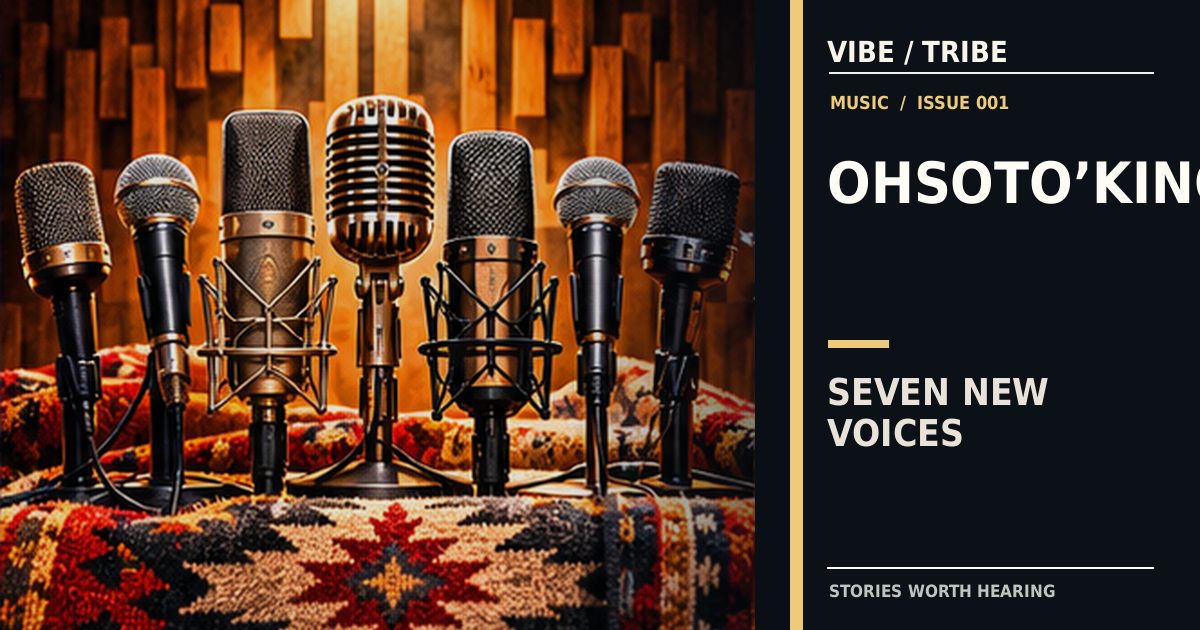
A talent pipeline is more interesting when it does not produce seven versions of the same artist. In September 2026, the National Music Centre announced a new cohort for its OHSOTO’KINO Indigenous music incubator. The names on the list make a useful listening assignment precisely because their sounds are different.
The selected artists were Big Tones, Chills, Ellescriv, Ger Carriere, Graeme Jonez, Stacie Arden Smith and Teagan Littlechief. Their five-day program was scheduled to culminate in a public showcase at Calgary's Studio Bell on September 17.
Three paths into the room
Anthony “Big Tones” Pasqua, born in Surrey and based in Saskatoon, brings hip-hop informed by culture, hardship and personal resilience. Ellescriv, a Saulteau First Nation artist, approaches songwriting from an alt-folk direction. Stacie Arden Smith's Northern storytelling takes a different emotional route again.
Three artists, three musical languages. The point isn't to rank them. It is to notice how unhelpful “Indigenous music” can become as a genre label when used without further listening. The communities, influences and production decisions behind each artist deserve more attention than a single umbrella category can supply.
Beyond the showcase
Music incubators offer time, resources and professional relationships, but a program mention is not the same as a full artist profile. Each performer still needs listeners to seek out the recordings, understand the work and follow what happens next.
For Vibe Tribe, this cohort makes a strong map for deeper reporting: independent artists with released material, distinct creative identities and new opportunities to meet audiences. Consider this a listening itinerary, not a declaration of who is about to become famous.
A cohort, not a genre
The 2026 OHSOTO’KINO Music Incubator brought seven Indigenous artists to Studio Bell in Calgary: Big Tones, Chills, Ellescriv, Ger Carriere, Graeme Jonez, Stacie Arden Smith and Teagan Littlechief. The five-day program culminated in a September 17 public showcase. The significance of the lineup is its range: rap, folk, country, pop and different regional approaches to songwriting all sharing the same professional setting.
That breadth challenges the familiar expectation that Indigenous programming must fit a single musical label. These artists are not substitutes for one another. A listener who is moved by the reflective folk of Stacie Arden Smith may find something very different in the theatre of Ger Carriere’s pop or the directness of Big Tones’ writing.
What professional development actually means
Programs like this are sometimes summarized as “exposure,” which obscures the practical work. The National Music Centre describes industry mentorship, collaboration and career guidance as major parts of the incubator. Teagan Littlechief’s later interview singled out communication with radio presenters, producers and engineers as an area where a working artist can still learn a great deal.
That is why access matters. A performance can create a memorable night; a relationship with someone who knows release strategy, production or music business can shape what happens after the night is over. Neither guarantees success, but both belong in any serious discussion of the music ecosystem.
The deeper listening guide
Begin with Big Tones’ “Shine,” then move to Ger Carriere’s “Can I Be Her,” Stacie Arden Smith’s “60th Line” and Ellescriv’s Wandering the Pine. Use each artist’s official page rather than relying on a single playlist. The point is to hear differences in craft and intent, not to select a winner.
The next step for Vibe Tribe is to treat incubator programs as a starting point for editorial follow-up: what did the artists make next, who did they collaborate with and did the new connections open further doors? That is where a sustained publication can do more than reproduce an announcement.
Hear it. See it. Follow the work.
A profile is a starting point. Experience the actual song, performance, release or project through the creator’s own channels.
Reported from credited public interviews, company biographies, festival or institutional records and published filmographies. Vibe Tribe did not conduct an exclusive interview for this story.